At 6 PM, the lanes around Banke Bihari Mandir get so crowded you can barely walk. At Prem Mandir, people queue up an hour early for the evening light-and-sound show. And if you stand outside almost any guesthouse near the temple belt, you’ll spot foreign devotees, many connected to ISKCON, who stay for weeks or even months at a stretch. This is the real texture of Vrindavan, and it’s where any serious conversation about buying property in Vrindavan or investing in real estate in Vrindavan should start.
- Quick Investment Snapshot
- Should You Invest in Vrindavan Property in 2026?
- Understanding the Vrindavan Property Market
- How Much Money Do You Need to Invest in Vrindavan?
- Best Property Investment Options in Vrindavan
- Studio Apartments vs B&B Homestays: Which Offers Better Returns?
- Best Areas to Buy Property in Vrindavan
- How Much ROI Can You Expect From Property Investment in Vrindavan?
- Legal Checks Before Buying Property in Vrindavan
- Common Mistakes Property Investors Should Avoid
- Final Verdict: Is Vrindavan Property Investment Worth It?
- Frequently Asked Questions
This guide walks through how that demand, from weekend crowds and festival surges to long-stay retirees and NRI devotees, translates into real opportunities (and real risks) across studio apartments in Vrindavan, B&B homestays, and holiday homes. You’ll get indicative budget ranges, the best-positioned areas, realistic ROI expectations, and the legal checks that protect you from costly mistakes.
Quick Investment Snapshot
| Factor | Verdict |
| Investment Potential | Moderate to High |
| Risk Level | Medium |
| Best For | Long-term investors, NRI buyers, spiritually-connected families |
| Passive Income Option | Studio Apartment |
| Active Income Option | B&B Homestay |
| Retirement / Personal Use | Holiday Home |
| Pure Appreciation Play | MVDA-approved Plot |
| Typical Holding Period | 5+ years |
| Entry Budget Range (indicative) | ₹15 lakh – ₹60 lakh+ |
| Biggest Risk | Unapproved colonies, seasonal income swings |
(Figures indicative: verify current pricing with specific projects.)
Should You Invest in Vrindavan Property in 2026?

Short answer: it depends on what you buy, where you buy it, and why. Vrindavan has real, tourism-driven demand and growing developer interest, but it’s an early-stage, seasonal market, not a guaranteed-return one. The sections below cover why investors are looking here, how seasonal demand really is, what infrastructure factors are realistic to count on, and a quick opportunity-vs-risk summary.
Why Vrindavan Is Attracting Property Investors
Walk down Chhatikara Road on a Saturday evening and the shift is visible: Delhi-NCR number plates, new guesthouses going up beside decades-old ashrams, and “studio apartment” signage that didn’t exist here a few years back.
- A pilgrimage base that never really shrinks: Vrindavan has drawn devotees for generations, including a steady international component, particularly ISKCON-linked visitors from the US, Europe, Russia, and Australia
- Longer stays becoming normal: visitors staying two weeks, a month, or longer in private accommodation rather than ashrams is increasingly common
- A market still finding its shape: fewer large branded projects than Noida/Gurugram, which some see as an opportunity, though it also means less transparency and more quality variation
Here’s where buyers often go wrong: assuming Vrindavan behaves like a beach town with predictable year-round tourism. It doesn’t. Demand moves in waves, and the shape of those waves matters more than the headline story.
Bottom line: the pull is genuine, but it’s layered: pilgrims, long-stay foreigners, retirees, and investors all want different things from a property, so “Vrindavan is popular” alone doesn’t tell you if your property will perform.
Tourism Growth and Rental Demand
Try booking a room during Janmashtami or the Holi celebrations at Banke Bihari and Barsana, everything fills up and prices climb. Visit in late monsoon on a regular weekday, and the same lanes feel almost sleepy.
- Peak season (Janmashtami, Holi, Radhashtami, and a few other dates): strong short-stay demand, near-full occupancy near major temples
- Off-season (especially monsoon): steady but lower footfall
- Long-stay segment: retirees and spiritually-inclined residents staying months, less seasonal, smaller pool
The real test: can a seller describe occupancy in September, not just during Janmashtami? If not, that’s a due-diligence gap.
Worth knowing: this pattern suits investors who can handle income swings through the year. It’s a poor fit if you need fixed monthly cash flow for an EMI.
Infrastructure Projects Supporting Future Growth
Ask around about future growth, and you’ll hear the same points: better Delhi-NCR connectivity, regional planning via MVDA and YEIDA, a sense that “this area is opening up.” Some is visible already; some is still on paper.
- What exists today: current road/transport links, which already shape accessibility
- What’s planned: broader regional development often cited in project marketing
- The catch: infrastructure timelines in India routinely slip by years
Ground reality check: if you can’t find recent, independent news confirming progress on a specific project, treat it as “planned,” not “happening”, and don’t price it into your return calculations.
Key Opportunities and Risks at a Glance
| Aspect | Opportunity | Risk / Limitation |
| Tourism demand | Long-running pilgrim base | Highly seasonal: big peak vs. off-season gap |
| Market stage | Early-stage may mean lower entry prices | Fewer comparables, inconsistent quality |
| Infrastructure | Could support future appreciation | Planned projects often delayed |
| Approvals | MVDA/RERA projects offer a paper trail | Unauthorized colonies carry real risk |
| Property types | Studios, homestays, holiday homes, plots | Each suits a different profile |
| Buyer fit | Suits long-term, patient holders | Poor fit for quick-flip or fixed-income-dependent buyers |
Understanding the Vrindavan Property Market
Before deciding what or where to buy, it helps to understand how this market behaves: how prices vary, who’s driving demand, what fuels appreciation, and where things are headed.
Current Property Price Trends
Compare listings near Banke Bihari versus a quieter residential pocket a few kilometers out, and the gap is obvious: location relative to temples and main roads is the biggest visible price driver.
- Proximity to temples: areas near Banke Bihari, Prem Mandir carry a clear premium
- Road frontage: Chhatikara Road-type locations price higher than interior plots
- Approval status: MVDA-approved/RERA-registered projects generally inspire more confidence
- Project type: studios priced per unit; plotted land priced per sq yd
Here’s the honest picture: there’s no single “going rate.” Get current quotes from 2-3 projects rather than anchoring to an ad’s headline price.
What Drives Property Demand in Vrindavan?
Four buyer types keep coming up in conversations here, each wanting something different:
- Pilgrims/short-stay tourists: drive demand for compact, short-stay accommodation near temples
- Long-stay residents/retirees: want comfortable units for extended stays, less rental-focused
- NRI buyers: often motivated by spiritual connection, value clear documentation
- Domestic investors: looking at appreciation, studio income, or homestay potential
The real test: which buyer type would want your property? A studio near Banke Bihari appeals to a different crowd than a quiet residential unit. Match your return expectations accordingly.
What Factors Influence Property Appreciation?
| Factor | How It Typically Influences Appreciation |
| Distance from major temples | Closer = generally stronger demand-driven appreciation |
| Road/connectivity improvements | Can unlock value in “interior” areas |
| Approval status (MVDA/RERA) | Approved projects hold value better |
| Tourism growth | Supports rental and resale demand |
| Regional infrastructure (NCR links) | Positive long-term, but timeline-dependent |
| Supply of similar projects | More supply can slow price growth |
Bottom line: score any property against this table rather than taking “this area is appreciating fast” at face value.
Market Outlook for the Next Few Years
- Tourism-linked demand likely remains the main driver: steady, not explosive
- Market formalization may continue gradually
- Infrastructure upside stays “watch and verify”
- Price growth, where it happens, is likely uneven, concentrated in well-located, approved projects
What this means for you: treat this as a multi-year hold, and revisit assumptions periodically.
How Much Money Do You Need to Invest in Vrindavan?
Budgets vary depending on whether you’re buying a studio, setting up a homestay, or going for a personal holiday home, each with its own ongoing costs. For current per sq.ft rates by locality, see our guide to Vrindavan property rates.
Studio Apartment Investment Budget
Studio apartments typically fall in the ₹15-30 lakh range. Premium projects near Prem Mandir or Banke Bihari can push into ₹30-45 lakh+; smaller interior developments sometimes start around ₹12-18 lakh.
- Base unit cost: varies by size, floor, location
- Payment plan: construction-linked or installment options common
- GST and applicable taxes
- Registration and stamp duty: UP state rates
- Optional extras: parking, club membership, furnishing packages
(Indicative only: request a current itemized cost sheet.)
Worth knowing: “extras” can add a meaningful percentage on top of base price. Compare total cost sheets, not headline numbers.
B&B Homestay Investment Budget
- Property cost: broadly ₹20-40 lakh
- Furnishing and setup: typically ₹3-8 lakh
- Registration/compliance costs: under applicable state homestay/B&B policy (verify current rules)
- Ongoing operational costs: utilities, housekeeping, platform commissions, maintenance
Here’s where buyers often go wrong: budgeting only the property cost and getting caught off guard by ₹3-8 lakh in setup/compliance before the first booking. For the actual step-by-step process, see our guide on the B&B homestay registration process in Vrindavan.
Holiday Home Investment Budget
Generally ₹18-35 lakh, budgeted like a standard residential purchase, without the homestay-specific setup layer.
- Property cost: based on size, location, project type
- Registration and stamp duty
- Basic furnishing for personal use
- Periodic maintenance: important since the property won’t be occupied year-round
The real test: personal use with occasional rental, or income-first with personal use as a bonus? Different investments, different ideal locations.
Registration, Maintenance and Other Ownership Costs
| Cost Type | When It Applies | Notes |
| Stamp duty & registration | At purchase | UP state policy: verify current rates |
| Maintenance charges | Ongoing | Common in apartment projects: ask for fee structure |
| Property tax | Annual | Payable to local authority |
| Society/association charges | Ongoing, if applicable | Security, common areas |
| Remote management costs | Ongoing, non-resident owners | Caretaker/property management |
Bottom line: net these out of any rental projection.
Best Property Investment Options in Vrindavan
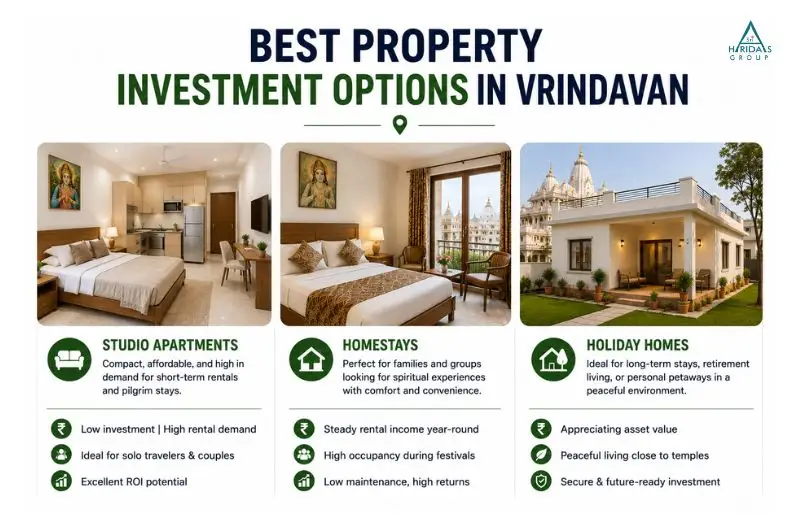
Vrindavan broadly offers three property types (studios, B&B homestays, and holiday homes), each with a different cost, effort, and return profile.
Studio Apartments
Advantages
- Lower entry cost than larger apartments/houses
- Organized developments: shared amenities, security
- Compact size suits short-stay demand
- Easier to manage remotely
Limitations
- Limited living space, not for large families
- Returns depend heavily on the specific project
- Resale liquidity still developing
- Maintenance charges and society rules apply
Best For
- First-time investors wanting lower-ticket entry
- Investors interested in incidental rental/homestay income
- Buyers comfortable with project-based ownership
Dwarka Puri Vrindavan is one example of a studio apartment project in this category, located in the Sunrakh Bangar area of Vrindavan.
B&B Homestays
Advantages
- Direct exposure to tourism demand: strong peak-season potential
- Operable from a single property
- Personal use possible in low-demand periods
- Aligns with the town’s core demand driver
Limitations
- Income is seasonal and fluctuates significantly
- Requires active management or a hired manager
- Compliance with homestay/B&B regulations needed (verify currently)
- Location-dependent, not every spot works
Best For
- Owners who can manage (or arrange management of) hospitality
- Investors prioritizing tourism-linked income over fixed returns
- Properties genuinely close to high-footfall pilgrim areas
Holiday Homes and Second Homes
Advantages
- Personal-use flexibility
- Lower management complexity: no guest turnover
- Long-term appreciation potential
- Appeals to buyers with personal/spiritual connection
Limitations
- Lower income potential than active rental/homestay
- Vacant periods require upkeep without offsetting income
- Returns lean on appreciation: longer horizon
- Less predictable resale timing
Best For
- Buyers with personal/family/spiritual connection
- Investors prioritizing appreciation + personal use
- Those avoiding homestay-level operational involvement
Investors exploring opportunities beyond Vrindavan can also consider other emerging property markets. Elixir Prana is one such project in Dehradun for buyers looking at long-term property opportunities.
Studio Apartments vs B&B Homestays: Which Offers Better Returns?
The right choice depends on capital, time, and tolerance for income variability, not which is “better” in absolute terms.
Investment Cost Comparison
| Factor | Studio Apartment | B&B Homestay |
| Initial cost | ₹15-30 lakh | ₹20-40 lakh + ₹3-8 lakh setup |
| Additional setup | Minimal | Significant |
| Typical buyer | First-time, lower ticket | Willing to spend more upfront |
Rental Income Comparison
| Factor | Studio Apartment | B&B Homestay |
| Income source | Long-term rental / appreciation-driven | Short-stay guest income |
| Consistency | More stable with tenant | Highly variable seasonally |
| Income ceiling | Capped by residential rates | Higher peaks, averages out |
Occupancy and Demand Comparison
| Factor | Studio Apartment | B&B Homestay |
| Demand driver | Long-stay residents | Pilgrims/tourists, festival-tied |
| Occupancy pattern | Stable with tenant | Seasonal peaks/troughs |
| Location dependency | Important | Critical |
Maintenance and Management Comparison
| Factor | Studio Apartment | B&B Homestay |
| Day-to-day involvement | Low | High |
| Remote ownership | Feasible | Difficult without local manager |
| Costs | Standard maintenance | Maintenance + hospitality upkeep |
ROI Comparison with Risk and Effort Scores
| Parameter | Studio Apartment | B&B Homestay |
| Primary return driver | Appreciation + modest rental | Operational income + appreciation |
| Capital Requirement | Low (₹15-30L) | Medium-High (₹20-40L+) |
| Risk Score (1-5) | 2 | 4 |
| Effort Score (1-5) | 1 | 4 |
| Investor Profile | First-time, passive | Hands-on, hospitality-minded |
Worth knowing: want “check in occasionally”? Studio in an approved project. Ready to actively manage? Homestay offers more upside: model on off-season occupancy, not festival numbers.
Best Areas to Buy Property in Vrindavan

Location is one of the biggest factors affecting both demand and appreciation. Below are five commonly discussed areas. Verify current conditions and project-specific approvals before deciding.
Chhatikara Road
A prominent connectivity corridor where much new development is happening.
- Connectivity: main-road frontage, easier access
- Development activity: more new projects due to road access
- Rental potential: supports long-stay and homestay accessibility
- Limitations: more noise/traffic than interior locations
Bottom line: good for accessibility priorities. Visit to judge the noise tradeoff yourself. ISKCON sits on this side of town; for unit sizes and prices there, see our guide to flats near ISKCON Vrindavan.
Rukmani Vihar
A primarily residential locality.
- Character: generally residential
- What to verify: MVDA approval, connectivity, amenities proximity
- Demand fit: more long-stay residential than tourist footfall
What this means for you: lean heavily on legal verification here. Locality reputation isn’t enough.
Raman Reti
Carries particular spiritual significance.
- Appeal: draws personal-connection buyers
- Considerations: check connectivity, as spiritually significant zones aren’t always well-connected
- Fit: suits personal-use/long-term residential intent over short-stay rental
Worth knowing: sentiment is valid, but run the same legal/budget checks as anywhere else.
Areas Near Prem Mandir
Evening crowds here are a good indicator of consistent footfall.
- Footfall: high and relatively consistent
- Pricing: premium for landmark proximity
- Competition: more existing accommodation options
Bottom line: strong demand driver, but weigh premium and competition against budget. Buyers focused on the temple belt can start with our detailed guide on studio apartments for sale near Prem Mandir, covering prices, location checks, and buyer suitability.
Areas Near Banke Bihari Temple
Among the densest crowds in Vrindavan during festivals.
- Footfall: among the highest, especially during festivals
- Pricing: likely higher end
- Congestion: affects accessibility at peak times
- Demand type: strongly short-stay/pilgrim-oriented
What this means for you: strong choice for capturing peak-festival demand, with realistic price/congestion expectations.
How Much ROI Can You Expect From Property Investment in Vrindavan?
ROI here isn’t a single number: it’s shaped by yield potential, appreciation trends, and several underlying factors.
Rental Yield Potential
- Property type/management intensity: active short-stay vs. passive long-term rentals differ significantly
- Location relative to demand drivers: proximity to temples supports occupancy
- Seasonality: annual yield must include off-season
- Net vs. gross: costs reduce gross to net
The real test: is a quoted yield annual-average or peak-season extrapolation? Gross or net?
Capital Appreciation Potential
- Appreciation is uneven: concentrated in well-located, approved areas
- Unapproved/poorly-connected properties risk stagnant value
- Plays out over a multi-year period
Bottom line: cross-check appreciation potential against location and approval factors.
Factors That Impact ROI
| ROI Factor | Why It Matters |
| Entry price vs. fair value | Overpaying reduces ROI regardless of performance |
| Ongoing costs | Reduce net returns directly |
| Occupancy/rental performance | Actual occupancy drives real income |
| Approval status | Affects resale and future transactions |
| Holding period | Allows appreciation/income to average out |
| Exit/resale conditions | Liquidity at sale affects realized returns |
Sample Return Scenarios
Scenario A: Studio, appreciation-driven: Held several years, minimal active management; returns mainly from appreciation. Verify: project track record, location fundamentals, approval status.
Scenario B: Homestay, actively managed: Realistic seasonal occupancy; returns from net operational income + appreciation. Verify: month-by-month occupancy, net costs, management arrangement.
Scenario C: Holiday home, personal-use-primary: Personal use part-year, occasional rental; returns mainly appreciation. Verify: vacancy, upkeep costs, growth fundamentals.
Here’s where buyers often go wrong: building the whole case around one rosy seller figure. Build conservative/moderate/optimistic models yourself, and treat unwillingness to share occupancy/cost data as a red flag.
Legal Checks Before Buying Property in Vrindavan
(General awareness only: not legal advice. Engage a qualified local lawyer for transaction-specific verification.)
Given how much approval status varies here, legal diligence is the difference between a safe investment and a costly mistake.
MVDA Layout and Sanction Plan Approval
- Verify layout-level MVDA approval (not just the unit)
- Check sanction plan matches actual construction
- Confirm any additional permissions relevant to the project
Bottom line: ask for documentation directly, and verify independently with MVDA where possible. As an example of how this verification looks in practice, you can read our breakdown of the MVDA approval status of Dwarka Puri Vrindavan.
RERA Registration for Large-Scale Projects
- For large projects, confirm the registration number on the UP RERA portal
- Smaller projects may legitimately fall below threshold
- For unregistered smaller projects, lean on other checks
Worth knowing: “no RERA number” isn’t automatically a problem: find out why.
Land Use, Title and Khatauni Verification
- Title verification: clear, marketable, no disputes
- Khatauni records: current ownership/classification
- Land use classification: matches intended use
- Encumbrance check: no pending loans/litigation
What this means for you: technical and document-heavy, so a local property lawyer is especially valuable here.
Registry, Mutation and Possession Documents
- Sale deed registration
- Mutation: update revenue records to reflect new owner (often overlooked)
- Possession documentation: formal handover confirmation
Bottom line: follow through on mutation, and keep possession documents safe for future sale.
Common Mistakes Property Investors Should Avoid
Most problems follow a handful of repeating patterns: here are the five most common.
Buying Non-MVDA Approved Unauthorised Colonies
Cheaper on paper, but carry risk around civic infrastructure, financing for future buyers, and resale.
- Lower pricing makes them attractive
- Buyers often miss the difference between “land with a boundary wall” and “approved layout”
- Risks: infrastructure gaps, harder resale financing, regularization uncertainty
Here’s where buyers often go wrong: falling for the price before checking approval. Flip that order.
Ignoring Actual Rental Demand
“Vrindavan has tourists, so it’ll rent” doesn’t account for location-specific and property-type-specific demand.
- Demand concentrates near major temples and during festivals
- Different property types attract different segments
Worth knowing: research demand for properties similar to yours, in your specific micro-location.
Assuming Every Property Can Generate Homestay Income
Not every property is eligible or suitable for homestay operation under current state regulations.
- Eligibility depends on compliance, location, and layout
- Requirements can change, so verify currently, before purchase
The real test: confirm eligibility before buying if homestay income is part of your plan. If you’re unsure whether your property qualifies, start by reading is running a B&B homestay legal in Vrindavan before making any purchase decision.
Focusing Only on Low Purchase Price
A low price ignores total cost of ownership, resale liquidity, and potential underlying issues.
- Doesn’t account for registration, maintenance, compliance costs
- A cheap property in a poor location may be hard to resell
- Can correlate with approval/title issues
Bottom line: evaluate price alongside location, approvals, and total ownership cost.
Skipping Due Diligence Before Booking
Urgency-based sales tactics push buyers to pay before verifying MVDA/RERA/title status.
- “Limited units,” “price increasing soon” create pressure
- Booking amounts can be hard to recover if issues surface later
Worth knowing: complete core checks before any booking payment. Pressure to “book first, verify later” is a signal to slow down.
Final Verdict: Is Vrindavan Property Investment Worth It?
Bringing it together: here’s who this market suits, who should be cautious, and a simple framework to match your goal to the right property type.
Who Should Consider Investing?
- Can hold for several years, not needing a quick exit
- Have a personal/family/spiritual connection adding non-financial value
- Comfortable with seasonal income (for rental/homestay)
- Willing to invest time (or hire help) for diligence and management
Who Should Avoid Investing?
- Need quick resale/high liquidity
- Require fixed monthly income to service debt
- Unwilling to engage in proper legal verification
- Basing decisions purely on a seller’s projected returns without verification
Decision Matrix: What Should You Buy?
| Your Goal | Best Option |
| Passive, low-effort investment | Studio Apartment |
| Active hospitality/business income | B&B Homestay |
| Retirement or personal spiritual base | Holiday Home |
| Long-term appreciation, low maintenance | MVDA-approved Plot |
Who Should Buy What: Quick Framework
- Budget under ₹25 lakh → Studio Apartment
- Want active/seasonal income, ready to manage → B&B Homestay
- Want a personal retreat for retirement/family → Holiday Home
- Want long-term appreciation, minimal involvement → MVDA-approved Plot
Key Takeaways for 2026 Investors
- The investment case rests on genuine, long-term tourism demand: but it’s seasonal, model returns accordingly
- Legal verification (MVDA, RERA where applicable, title/khatauni, registry/mutation) is non-negotiable
- Property type should match your goals: studios, homestays, and holiday homes serve different purposes
- Infrastructure optimism is potential upside, not a baseline: verify independently
- Location-specific due diligence matters more than town-wide reputation
- This is generally a longer-horizon investment: patience over short-term targets
Frequently Asked Questions
Quick, direct answers to the questions investors most commonly ask.
Is Vrindavan property a good investment in 2026?
For long-term buyers willing to do proper due diligence (MVDA, RERA, title checks), yes, it can be reasonable. For those wanting quick resale or guaranteed fixed income, it’s a weaker fit. Treat it as a multi-year hold.
What is the average ROI on property in Vrindavan?
No reliable “average” exists. ROI depends on property type, location, approval status, and management effort. Evaluate each property individually using the ROI factors covered above.
Are studio apartments profitable in Vrindavan?
They can be, though returns usually come more from appreciation than high rental yield. Profitability depends on the specific project’s location and pricing, so verify details before assuming returns.
Can I run a homestay in Vrindavan?
Yes, but it depends on compliance with applicable state homestay regulations and the property’s location/layout. Verify current eligibility rules independently before buying for homestay income.
Which area is best for property investment?
Depends on your goal. Areas near Banke Bihari/Prem Mandir suit short-stay/homestay demand but cost more. Chhatikara Road balances access and pricing. Quieter residential pockets suit long-stay or personal use.
Is MVDA approval mandatory?
MVDA-approved layouts are the safer standard. Unauthorized colonies carry real risks around infrastructure, financing, and resale. Always verify approval status before booking, ideally with a local lawyer.
Do all projects in Vrindavan require RERA registration?
No. Registration depends on project size/unit-count thresholds. Smaller projects may legitimately fall below this. If a project should be registered, verify the number on the official UP RERA portal.
What budget is required to invest in Vrindavan property?
Studios are generally the lowest entry (₹15-30L), homestays need property cost plus ₹3-8L setup, and holiday homes follow standard residential budgeting (₹18-35L). Always get a full itemized cost sheet.
Note: This guide is for general informational and educational purposes to support property research and decision-making. It does not constitute legal, financial, or investment advice. Prices, regulations (RERA, MVDA, homestay/B&B policies), and infrastructure statuses can change, so verify current information independently and consult qualified professionals before investing. Studio Apartment Investment in Vrindavan: Complete Buyer’s Guide for Investors (2026).